Binance joins Neo Council, 2.1 million NEO used to secure two Top 21 positions


Binance Staking has secured two positions on the Neo Council. At the time of press, Binance has voted with approximately 2.1 million NEO to secure its places in the Top 21.

Binance is the world's largest custodial exchange with nearly US $9.07 billion in 24-hour volume, according to CoinCap.io. Binance Staking is a service that allows users to earn distributions offered on proof-of-stake or other networks that distribute rewards to participants.

The platform provides two types of staking: flexible and locked. Flexible staking offers fewer rewards but allows users to move the underlying assets at any time. Locked staking requires users to deposit a token for a specific time frame but provides higher yields. For example, a minimum of 0.01 NEO locked for 15, 30, 60, or 120 days will earn increasing yields of 5.79%, 7.49%, 8.79%, and 13.56% (made in GAS distributions), respectively.

In the announcement post, Neo Global Development said "Binance Staking's new membership in the Neo Council is expected to bring new diversity to the Neo community and increase cross-platform user engagement for both parties."

Under Neo's governance mechanism, NEO holders use their tokens to votes in 21 nodes that serve on the Neo Council. The Neo Council's task is to maintain the network's health and liveness. Council members vote on issues impacting the state of the Neo network, such as blockchain parameters (i.e., fees) and electing other onchain roles (i.e., oracle nodes, NeoFS ring nodes).

To vote, a wallet points its address to a candidate, and any NEO held in that wallet designates favor of the Council member. Neo Council members receive a proportional 10% share of the 5 GAS distributed in each new block. NEO holders that vote for Council members will receive 80%, and the final 10% is distributed among all NEO holders, regardless of if the tokens are used to vote or not.

Lyrebird launching Neo N3 stablecoin protocol on Friday, April 29


Lyrebird is launching its algorithmic stablecoin protocol on Neo N3. Lyrebird's dollar-pegged token, USDL, and the stabilization utility token, LRB, will be released through Flamingo's reverse liquidity pools and through upcoming "airdroplet" events. Airdroplet is a designated term to differentiate initial, smaller airdrops from general airdrops that will occur as the Lyrebird ecosystem matures. The FRP-FLM-LRB pool will launch between 9:00 and 10:00 a.m. (UTC) on Friday, April 29, 2022.

The Lyrebird reverse pool will be seeded with 5 million LRB, which at an initial price of US $0.01 per LRB means it will have an equivalent worth of $50,000. The LRB will be paired against an equivalent $50,000 in FLM.

Approximately 1.5 million LRB will be released through Flamingo's reverse liquidity pools each year. Reverse pools allow users to stake LRB or USDL along with another token into a pool and, in return, receive LRB or USDL tokens as a reward.

Airdroplet Distribution
The first round of LRB airdrops will go to Lyrebird ecosystem participants for being early members in the Discord server or for testing the protocol on Neo N3 TestNet. The Lyrebird team anticipates distributing approximately 500,000 LRB through airdroplets, and there are no time-lock restrictions on any of these distributions. The snapshots for those who qualified have already been taken and will not be modified.

There are approximately 60 addresses on Neo TestNet that own LRB or USDL, and each address will receive an airdrop of 5,000 LRB tokens.

Roughly 260 Discord server members qualified for the airdrop and have already been whitelisted. Server members with green-colored handles have been approved, and those with yellow should be processed soon. Those who qualify will receive 1,000 LRB each.

Lyrebird Stablecoin Pool
The Lyrebird USDL stablecoin reverse liquidity pool will launch on Flamingo when the price of LRB shows signs of reduced volatility. The team states the purpose of the LRB token is designed to absorb USDL's volatility. Therefore, the pool will launch once the market has determined a relatively consistent value for LRB.

When the FRP-USDL-FLM reverse pool launches, there will be $50,000 USDL paired against $50,000 equivalent in FLM. However, rewards for the reverse pool will be distributed in LRB.

The Lyrebird team aims to incentivize on-demand minting of USDL through the Lyrebird website instead of releasing the stablecoin through reverse pool rewards. Therefore, the FRP-USDL-FLM pool will distribute LRB, with the goal that users will swap LRB for USDL, then provide it as liquidity in the reverse pool.

GrantShares DAO launching to support ecosystem growth and grassroots initiatives


The GrantShares DAO is launching on Neo N3 to distribute funding to grassroots developers and ecosystem beneficial projects. The DAO will manage an initial treasury funded by the Neo Foundation.

As the first DAO to launch on Neo N3, GrantShares is designed to provide financial support to smaller initiatives that do not currently fit the scope of Neo's existing grant programs. Voting members of the organization include COZ, AxLabs, Red4Sec, NGD Enterprise, NeoResearch, NEXT, Neo SPCC, Neo Foundation, Neo Global Development, and Neo News Today.

Anyone is encouraged to submit a proposal for the members of the DAO to discuss and vote.

The initial funding limit for GrantShares is $50,000 per proposal, and can be used to fund local events, dApps, developer tools, education initiatives, and more. Projects seeking larger amounts should apply for grants through one of Neo's Eco Support tracks.

The DAO's smart contracts are developed and maintained by AxLabs and have already been deployed to the Neo MainNet. In the coming weeks, AxLabs aims to release the accompanying dApp for applicants to submit proposals. The dApp will create an issue in the GrantShares repository where DAO members can discuss the potential grantee's proposal before voting.

In addition to distributing funding, AxLabs designed the GrantShares smart contracts to serve as a reference implementation for other N3 developers. The DAO contracts are open-source on the GrantShares repository.

The GrantShares dApp is tentatively expected to launch in mid-April 2022.

Papa John’s Use The Tezos Blockchain To Give Away Free NFT


Papa John's NFT Bag Giveaway
Papa John's is using the Tezos blockchain to give away free NFT bags designed by two talented NFT designers; Tom Hoff and Ash Sketch. One lucky winner given the chance to with a real-life version. The NFTs can be claimed here.

There are nine NFT bags from 19,840 to choose from and claiming a bag enters the owner into a draw to win a collectible real-life Papa John's bag, with the winner being chosen on the 14th April 2022. This will be the 'Papa 1984' yellow bag, by Ash Sketch.

The bag is worth £250 and users are able to mint one NFT bag per wallet in order to enter the draw.

Papa John's is the fourth-largest pizza delivery restaurant chain in the United States, operating over 5000 restaurant locations worldwide. The pizza bag giveaway will represent the company's first foray into the NFT market and for this they chose to utilize the environmentally friendly Tezos blockchain in order to distribute the offering.
Papa John's stated:

Most Proof of Work blockchains are very inefficient and wasteful by design. They can use millions of times more energy than modern Proof of Stake blockchains like Tezos. By comparison, creating and trading NFTs on Tezos takes around the same amount of energy as sending an email or a social media post.

Last year big rival Pizza Hut entered the NFT market with their pizza art NFT offering.

People will be able to buy the real-life versions of these bags in an exclusive drop of five real Papa 1984, Papa Cheese Melt and Papa Tag bags which will go on sale via Depop, the fashion marketplace, on 7 March 2022. 

Payvo is Coming - ARK.io


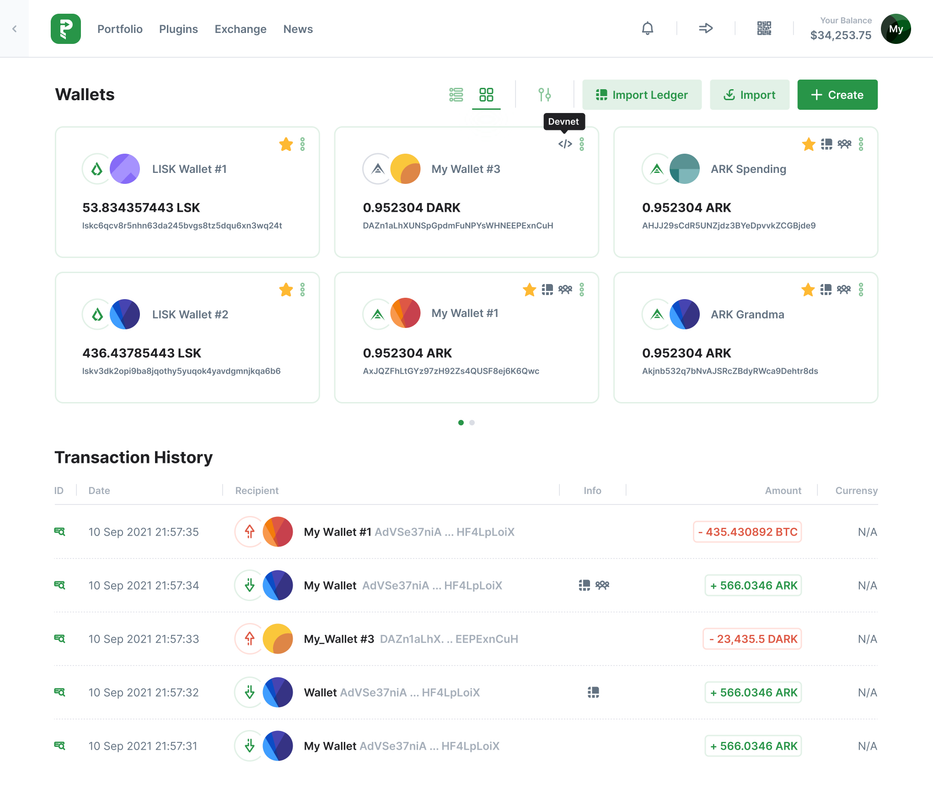
Payvo is coming, and it is going to be our best wallet yet! Read on to find out everything that has changed since our last update, including the transition from a desktop app to a fully web-based application. There is a lot to cover, so let's get straight into it!

#Payvo is Now 100% Web-Based
When we set out to build a next-gen wallet, we had a few key goals in mind:

  1. Payvo needs to be the best white label out-of-the-box solution possible.
  2. Payvo needs to easily integrate with any ARK-based network.
  3. Payvo needs to be user and developer friendly while featuring the intuitive interfaces we have become known for.
  4. Payvo needs to be modern and future-proof.
  5. If you have spent any time with Web3, then you are probably familiar with the major shift towards web-based interfaces for both DeFi and wallet management. The truth is, desktop applications are outdated, so we need to make sure that we keep up with industry standards and trends. There are a lot of benefits with a move towards a web-based application, so let's take a look at a couple of the most important ones.

#Payvo Will Always be Up-to-Date
One of the most frequent support emails we get is that someone cannot see their funds, or they stopped receiving rewards from their delegate, or that their wallet is, in some way, failing to properly update the network data. In almost all cases, the solution is to update the wallet to the latest version.

With Payvo, you will always be up-to-date, meaning you will no longer have to worry whether you have the most recent version or not—it will just work. Period.

This also means that it is easier for us to push regular updates and make changes without disrupting you as the user. This leads to a better development cycle and an ability to create a more seamless interface for the end user.

#One App, Multiple Operating Systems
With the shift to a web-based application, Payvo will effectively become 'one-size-fits-all.' Whether you are on a desktop, laptop, iPad, or mobile phone, Payvo will provide a unified experience across all of your devices. Simply access the URL, and you are off to the races!

This greatly benefits developers who no longer need to maintain multiple codebases or submit to Apple or Google for approval of the mobile app. This greatly reduces the time required to get your fork up and running and makes maintenance easy.

Not only that, but the web-based application eliminates some of the restrictions caused by the previous use of Electron. This will make some features more efficient and easier to work with (such as web workers). Payvo also loads faster, runs smoother, and generally provides a better experience for both users and developers.

#White Label and Built for ARK
The shift to a web-based application is merely one of the only major changes with Payvo. We have spent a lot of time looking at our goals as a company and have put significant effort into getting back to basics. While we originally envisioned Payvo as a multi-wallet that would support BTC, Ethereum, and other assets, we feel like we need to stay squarely focused on providing the best possible solution for the ARK Ecosystem and those who fork the ARK Blockchain Framework.

As such, our goal is to make Payvo the best possible white-label solution for ARK Based networks and focus on making it plug-and-play within the ecosystem. With this change, we will also be moving away from running 'Live Service' applications directly from the ARK Ecosystem, SCIC. Everything that we build will be freely available as open-source software for anyone to run. We do not want to be the single point of failure nor pick and choose which networks matter the most. We love all of our bridgechains and want to give each and every one of them the opportunity to provide a robust application suite and set of features to their communities.

All we ask is that you leave the license in place, give us credit where credit is due, and if you get famous, give us a shout and let us know all the cool stuff you are doing!

#So When Can We Use Payvo?
We expect to have a public beta version available within the first half of March. The beta version will be fully functional and support the following features:

Fully Customizable Networks - Decide which networks you want to see inside the wallet as well as those you don't want to interact with.
Custom Networks - Add any v2.7+ Core-based network to the Payvo Wallet by providing a valid node address.
Server Management - Add your own custom nodes for interacting and/or broadcasting transactions. You are in full control (if you want to be).
Swap Integration - Payvo will come with built-in integration for both ChangeNow and Changelly at launch.
News Feed - Payvo will feature a news feed powered by FTX (previously Blockfolio) for relevant (listed) networks (only ARK at launch).
We could not be more excited to get Payvo into your hands. We believe these changes make for the best wallet we have ever produced and will provide for a more robust, futureproof white label solution for ARK Based Blockchains. Stay tuned to our blog so you do not miss out on the upcoming Beta. We cannot wait to hear all your feedback!

Tezos Records Highest Number Of Contract Calls In January With Several Dapps Set To Launch


A Smart Contract Call Record
Contract calls are interactions with smart contracts in the form of transactions. This is an important metric to see growth in the adoption rate of mainnet smart contracts. Since July 2020, the amount of contract calls has increased to 1,209% of the July total.

Every month we've seen a new record in the number of contract calls (except for November, which had a 10% drop).

January saw a 22% increase compared to December. At 22% it sounds ok, but if put this growth into perspective, we see that that 22% is 2.2 times the total amount of contract calls in July last year. We're witnessing exponential growth.

If we're looking at developer activity, we also continue to see growth in activity. In December, we saw an average of 700 daily new deployments on testnets. But in January, we see an average of 930 daily new deployments.

February is set to bring a lot of new launches and milestones.

Edo
The latest protocol upgrade will go live on mainnet in the second week of February. This is a feature-packed upgrade that includes privacy features.

This means that developers can easily integrate privacy into their smart contracts, which will enable them to provide private transactions and develop "privacy-conscious" applications.

Edo also introduces Tickets. Tickets is a convenient mechanism for smart contracts to grant portable permissions to other smart contracts or to issue tokens.

Tickets will be improving challenges like concurrency, which is a general issue developers face, especially in decentralized smart contract platforms.

Tickets also enable a more efficient way of interacting between contracts. It will enable self-custody of first-class coins/token permissions and improve the developer experience.

These are just a few of the advantages Tickets will bring and you can read more about tickets here.

Kalamint
Kalamint is a platform that can be used to create, sell and collect NFT's. Besides the advantage of low Tezos fees over high fees on Ethereum-based NFT platforms, Kalamint will have a unique governance design that includes a Guild.

We'll do an extensive article on Kalamint before they launch the platform on the 18th of February.

TEZEX
TEZEX is a cross-chain gateway to Tezos. It will enable value to come from Ethereum to Tezos DeFi in a few clicks. After that, users can move away from the current fees on Ethereum, and experience a drop in costs that is on average 3,000 times cheaper on Tezos.

When TEZEX launches, another crucial instrument joins the Tezos DeFi landscape.

Quipuswap
This is the second Decentralized Exchange (DEX) that is built on Tezos. Chances are that it will launch in February. This does, however, depend on the progress of the external audit of Quipuswap.

Kolibri
Kolibri is an algorithmic stable coin, built on Tezos and backed by XTZ. A February launch of Kolibri could be a bit optimistic to expect, but a testnet was released in the beginning of January, so there has some significant progress.

1,000,000 accounts
In February, Tezos will quite likely reach the milestone of 1,000,000 funded accounts.

With currently 945,284 funded accounts, and  97,253 new funded accounts in the past 30 days, ~55,000 account are likely to get created this month and break the 1 millionth milestone.

Reinstating Smartphone Access with Lisk Mobile v2.0.0


On the 21st of August 2021, we migrated the Lisk Mainnet to v3 which introduced numerous improvements to Lisk, such as multisignature accounts, a new address system, a new DPoS consensus algorithm, and a dynamic fee system. In order to meet internal deadlines, we had to focus our development resources on delivering these new improvements. This resulted in moving all frontend development resources to Lisk Desktop, hence compromising the availability of Lisk Mobile on launch day.

Today, we are proud to announce the release of Lisk Mobile v2.0.0 which reintroduces the core feature of Lisk on smartphones. Namely, the convenient sending and receiving of transactions. More advanced features like voting or multisignature accounts are solely available on Lisk Desktop to give our community the easiest and most user friendly experience on their mobile devices.

The next release will be Lisk Mobile v3.0.0, and will provide access to the Lisk interoperability solution which marks the launch of the Lisk blockchain application platform later this year.

New Features in Detail
Lisk Mobile v2.0.0 focuses on four topics, the access to Lisk v3 and its various new features, user experience and design improvements, Bitcoin support removal, and finally the overall security enhancements.

Access to Lisk v3
The recent major update of our Mainnet to Lisk v3 brought a wide range of new features and improvements to Lisk. From improved scalability to much lower fees, including a more decentralized DPoS blockchain and network, to a completely secure address system. In fact, as these are such major improvements it is highly recommended to view our announcement blog post of the Lisk Mainnet v3 migration, also please make sure to read the linked articles.

Internally, Lisk Mobile has a special focus. To be the most accessible wallet for the Lisk ecosystem. Taking that into consideration we have purposely limited the available feature-set solely for the sending and receiving of transactions.

User Experience and Design Improvements
Since releasing the previous Lisk Mobile we have been busy collecting community feedback to enhance and improve it even further. With Lisk Mobile v2.0.0 we focused on delivering many improvements to make its usage even easier and more convenient, as well as more consistent with our brand as can be seen in the images below.

Dashboard
Send LSK
Bookmarks

Stratis Interflux


The further development of Stratis' InterFlux protocol has been quietly simmering, focusing on incorporating Token Swaps between Ethereum and the Cirrus Blockchain, enabling popular ERC20 Tokens to find their way to the Stratis Ecosystem. The added functionality within InterFlux is a critical development for Stratis, further bridging the gap between Stratis Blockchain Technologies and Ethereum.

Active projects, such as Opdex, the first wholly decentralized exchange on Stratis, benefit significantly from this further development. Providing the availability and access to popular and established tokens on Ethereum, such as USDT (Tether), Binance USD, SHIBA INU, Wrapped Bitcoin (wBTC), and many more. Testing has already begun internally, with deployment to Testnet expected to occur in the coming days. A two week testing period will be undertaken on Testnet, with the view to promote to Mainnet after successful test criteria is met.

The further development also lays the foundation for supporting the ERC721 standard. Enabling the transfer of NFTs on Ethereum to Stratis for listing on Stratisphere.com resulting in NFT sales incurring 0% Platform Fees and significantly reduced transactional costs. You should expect to see some high-profile transfers occur once the ERC721 becomes activated in the near future! Stratisphere.com is the worlds first zero-fee decentralized NFT Marketplace, offering ultra-low transactional costs and a great user experience. Hundreds of NFTs have already been sold by various content creators using the platform, some of which are established community members with hidden talents, and some are brand new to our ever-growing community!

As always, development progress and community participation requests can be seen within our Discord Server. Be sure to join to keep track of the progress and get involved with testing the new functionality on our Testnet.


Neo project wins second place in Metaverse Alliance hackathon with 3D world platform


Neo community developer Robert Oschler has won second place in the SocialFi category of the Metaverse Alliance hackathon. Oschler's project, Neo3D Live, is a 3D metaverse world that allows users to interact with one another's avatars and participate in events like real-time auctions.

Oschler developed Neo3D Live so that anyone in any part of the world can access the 3D world, regardless of their ability to purchase powerful equipment. Neo3D Live was designed for most of the world's internet users – those without VR headsets or high-end equipment. He said:

Let Metaverse residents form meaningful connections in a virtual world that will run on common hardware, including the millions of smartphones that may be the only link to the Metaverse a citizen in an economically disadvantaged region has. This is a link that has the true power to uplift the millions, if not billions of hard-working, intelligent, decent human beings who have the misfortune of being born in a region that is not economically gifted like other parts of the world.

The platform leverages the ThreeJS graphics library, a graphics engine that is widely accessible. Neo3D Live runs on almost any browser and device, so there is no need for high-powered computer setups.

The platform's beta version allows users to congregate in a digital 3D environment. Real-time video conferencing is embedded into the moveable characters, so participants can see those they're communicating with via live video feed. Oschler said, "By combining true video conferencing where participants can see each other's faces as they talk to one another and move about a fun virtual world, people can once again feel the natural human joy of forming groups based on both social and spatial relationships like they would at a party or a shopping mall."

Oschler also incorporated other elements to make the space feel more natural and interactive. In Neo3D Live, intelligent objects are embedded in the virtual world, responding to an avatar's presence. For example, walking up to a wall with an embedded YouTube video will trigger the video to begin playing. And to create a more real-life experience, a user can hear the sounds of their movements and that of others around them.

NFT Showcase
The first demo of Neo3D Live included the NFT Showcase, a custom room where an individual can purchase an NFT on auction. A demonstration of the live auction can be found below:

The NFT designer can determine who can participate in the Showcase by whitelisting public wallet addresses on Neo N3.

The Neo3D Live smart contract supports derivative commissions, so collectors can earn profits when they sell an artist's NFTs if the artist grants them that right. Further, Oschler intends the NFTs bought and sold through Neo3D Live to be viewable and transferable via third-party marketplaces (i.e., Sky Hut, GhostMarket).

Looking forward, he aims to develop and release a drag-and-drop toolkit (that doesn't require coding ability), so anyone can build a virtual world.

Tezos Seals Partnership With Esports Giant Team Vitality


Tezos has secured a partnership with French esports giant Team Vitality. The three-year deal aims to bring Team Vitality closer to its fans than ever before by leveraging Tezos' energy-efficient blockchain.

Tezos Enters Esports Space
Tezos has entered into another game-changing partnership.

The Layer 1 blockchain, which prides itself on energy efficiency, announced a three-year partnership with French esports organization Team Vitality Thursday. Although details about what the partnership entails are still vague, Team Vitality stated that the deal would "revolutionize" its fan experience.

As part of the new deal, Team Vitality explained that the collaboration would help educate their fans on the benefits of blockchain as part of the gaming experience and showcase the advancements of these technologies. Additionally, the organization's CEO Nicolas Maurer explained what the partnership would mean for the esports team, stating:

"This is truly a game-changing partnership for Vitality, which feels appropriate given 2022 is set to be the biggest year in our history. The opportunities Tezos can bring to strengthen the relationship between us and our fans is incredibly exciting, and we're immensely proud to have Tezos join us on this journey."

For Tezos, the partnership appears to include brand visibility, possibly in the form of sponsorship logos on Team Vitality players' jerseys. "Tezos will be represented by top-performing Team Vitality rosters and star athletes and through unrivaled brand visibility across the esports ecosystem," Team Vitality said in a press release.

Last year, Tezos signed several major partnerships to boost its visibility. In June, Tezos made deals with Formula One racing teams McLaren and Red Bull Racing to launch collectible NFTs. Both teams stated that Tezos' low carbon footprint factored into partnering with the blockchain.

Last month, video game developer Ubisoft announced it would be launching NFTs on the Tezos-based Quartz platform, only to be hit with severe backlash from the gaming community. Despite this, Ubisoft put out a statement confirming that it will still pursue non-fungible tokens, explaining that the move is "a major change that will take time."

Despite attracting a lot of attention from brands, Tezos has otherwise struggled to gain significant momentum in the crypto space in recent months while other competing Layer 1 blockchains have seen huge growth. Musicians, artists, and art collectors appear to be some of the blockchain's biggest enthusiasts (besides Ethereum, Tezos is arguably the biggest hub for digital art NFTs, and it's also hosted NFT collections from the likes of Mike Shinoda and Doja Cat).  

Through its new partnership with Team Vitality, Tezos will be hoping to attract a new demographic of esports fans. However, after how poorly Ubisoft's foray into NFTs was received, whether Team Vitality's fans will be receptive remains to be seen. 

Saffron Finance seeking beta testers for Neo N3, distributing 30 Neoverse blindbox NFTs


Neo users can beta test Saffron Finance V2 by staking and withdrawing SFI, NEO, and GAS on the N3 TestNet. Saffron is also giving away 30 Neoverse blindboxes to users who provide feedback.

To participate, beta testers must first acquire TestNet NEO and GAS from the Neo N3 TestNet faucet, which can distribute 50 NEO and 50 GAS per IP address every 24 hours. Then, testers need to request SFI TestNet tokens in the Neo Saffron Beta Testing Telegram channel. The NeoLine Chrome extension wallet is required to use Saffron.

The Saffron V2 beta platform currently offers a dashboard displaying the total value locked for each coin and APR rates for rewards (distributed in SFI). Additionally, users can deposit and withdraw NEO, GAS, and SFI from single-sided staking pools.

According to Psykeeper, Saffron founder, initial plans for the platform's launch on Neo include single-sided staking, followed by adding support for Flamingo. The Saffron development team plans to integrate with Flamingo on the N3 TestNet first, before MainNet.

At the time of press, there is a tentative late-Feb. 2022 timeframe for Saffron's launch on N3 MainNet.

Saffron is also giving away 30 Neoverse blindbox NFTs. To become eligible, participants need to email dingo@saffron.finance and share the N3 address they used for testing along with a minimum of one sentence of feedback about their experience.

About Saffron Finance
Saffron is a peer-to-peer risk management platform. It distribute yields according to liquidity deposits in particular tranches and offers an insurance fund that generates yields. Saffron offers its users a selection of risk profiles for its supported liquidity pools.

There are three tranches that depositors can utilize: senior, junior, and fee. If an event requires funds to be covered, such as a mass liquidation event, assets from the junior tranche and insurance fund will cover the senior tranche first, then the junior tranche. Junior tranche deposits receive a higher portion of the platform's earnings in exchange for their lower coverage priority.

Saffron joined the N3 Early Adoption Program in Oct. 2021, with the intention to launch a liquidity mining service on Flamingo Finance. The Saffron ecosystem utilizes a governance token, SFI, which liquidity providers must stake to gain access to higher-yield tranches. When Saffron V2 launches, SFI stakers will also receive fees from swapping and staking activities on the protocol.

NULS POCM Upgrade Announcement


NULS POCM (Proof of Credit Mining) platform was established in July 2019, the number of our SCO partners has increased 10 times within 2 years. Some of the SCO projects such as ALEPH, GGTK, SmaugsNFT have accomplished amazing progress with the community support provided by NULS in their early phase, our SCO investors also gained quite good profits participating in the SCO projects. We are very happy to witness this double win situation and we, the NULS team, will keep moving forward to provide more benefits for our SCO partners and NULS investors.
NULS POCM is probably one of the simplest ways to invest in the initial market without any financial risks. Investors stake NULS in our POCM platform to earn tokens from our SCO projects.

There are 2 ways to participate in our SCO projects now:
Stake in SCO projects on web wallet(https://pocm.nuls.io
Stake in SCO projects on Nabox mobile Wallet. Download Nabox: (https://nabox.io)

We have been continuously receiving suggestions and feedback from our community members and SCO partners and investors ever since the POCM platform was established, to provide a better user experience, we have now updated our product in the following aspects:
Crossed-chain assets will be able to create POCM directly. New SCO projects investors no longer need to swap tokens on NeerveDEX (https://nervedex.com)
SCO projects creators give extra rewards to node owners according to their own wills.
SCO staking APR will be seen on the POCM page.

POCM page will show the current staking details such as the amount of NULS staked, the profits earned, etc
We reconstructed the staking logic.
Useless nodes will be deleted automatically to improve user experience.

NULS POCM staking platform now supports projects from ETH, BSC, NULS, Heco, OEC, Polygon, KCC, Tron, Harmony. We will be adding more diversities in the future to meet various needs from users.
About NULS POCM

POCM (Proof of Credit Mining) is an SCO Platform that allows projects to use smart-contracts to issue and distribute project tokens on blockchains. Got NULS? Stake into a project's nodes and earn their token as reward, while the project earns NULS as reward. Projects can use the NULS consensus rewards to bootstrap and help fund development. Unlike IEOs and ICOs, stakers never risk their principal, and NULS never leave their wallet. Earn project tokens while your device is off! As a universal SCO Platform, POCM can be used to issue and distribute tokens and assets from any public chain in any blockchain ecosystem.


Join The Stratis Build Hackathon with $100,000 USD in prizes


Stratis is genuinely excited to launch its third hackathon, bringing in new talent and blockchain solutions, demonstrating the power of Stratis Blockchain Technologies. At Stratis, our mission is to simplify the adoption of blockchain technology within existing computing environments. We have built a platform written entirely in C# and based on the Microsoft .NET Core framework to deliver on this mission. The Build – Stratis Platform Hackathon is Stratis' third virtual hackathon.

$100,000 USD has been allocated to the Hackathon Prize Pool, with a $30,000 USD Grand Prize and several other prizes to entice developer engagement. Stratis has also brought in some of its partners to sponsor the hackathon, including CMS, Triad Group Plc and the APPG, with CMS and Triad awarding a $5,000 bonus for those who deliver a submission that meets some of their defined requirements.

The Stratis Build Hackathon will launch on the 29th November 2021 and run for just under nine weeks, ending on 30th January 2022. This will be followed by a judging period, with winners being announced on 23rd February 2021.

The entry criteria are limitless; the only requirement is that your submission utilizes Stratis Blockchain Technology. An example of some submission types can be found below:

Blockchain Gaming Submission
Gaming submissions should include an end-to-end game, incorporating Blockchain Technology in some respect. This can be through the employment of an earn to play model, the issuance of non-fungible tokens or utilizing Smart Contracts to offer a genuinely trustless experience for the gamer.

Stratis provides Software Development Kits for both the Unity Gaming Engine and the Unreal Gaming Engine to assist with the game integration process.

DeFi Submission
A DeFi submission can implement a lending protocol, trade management solutions and anything related to financial services on the blockchain.

NFT Tooling Submission
An NFT submission should focus on tooling around the management, creation and utilization of NFTs. For example, an NFT Platform, NFT Creation Tooling and anything related to the management of NFTs. An NFT Collection can also be submitted but must stand out and be highly unique to pass judging criteria.

Stratis Platform Tooling Submission
A tooling submission must focus on bringing additional tooling to the Stratis Platform, such as an SDK that caters for an alternative programming language, or as another example, a wallet implementation.
The judges will be asking: does the tool provide a useful function, is it accessible and engaging to use, is it doing something innovative, how well does the product function? Submissions can cover any software application, such as the web, cloud, personal computer, mobile device or console, but they must utilize Stratis Smart Contracts in C#.

Now is the time to gain some inspiration and think about solutions you can build on the Stratis Platform, utilizing Stratis Blockchain Technologies, in readiness for the Stratis Build Hackathon launch. The launch of the hackathon will detail full judging criteria and getting started packs to assist those new to Stratis Blockchain Technologies.

Payvo Wallet - Overview of the Upcoming Alpha Version


What Is Payvo Wallet?
Payvo Wallet is a desktop-based multi-asset cryptocurrency wallet designed for Windows, MacOS, and Linux. While many wallets already exist on the market, Payvo is unique in that it is completely open-source, runs on the open-source Payvo SDK for multi-asset integration, and features a wide range of customizations that let you truly personalize your wallet experience.

#A Truly Open Wallet
The Payvo Wallet is fully open-source and will be available on GitHub. The Payvo SDK which powers the multi-asset nature of Payvo is also completely open-source and available on GitHub. We believe that the best way to push the industry forward is to build fully open-source and decentralized systems with no compromises.

By utilizing the Payvo SDK, we can integrate a wide range of different cryptoassets and tokens which will be seamlessly integrated with the entire Payvo suite of products. To find out how you can get your project added to the Payvo SDK, make sure to read our documentation .

#Powered by Choice
The Payvo Wallet is unique in that it was built to empower the user by giving them a plethora of options to customize their wallet. That includes but is not limited to:

Choice of Assets - Payvo Wallet is multi-asset and will feature a growing list of available native assets and tokens.
Choice of Swap Engine (Exchanges) - Payvo Wallet will feature a wide range of swap engine integrations so that the user can choose which one works the best for them.
Choice of Plugins - Payvo Wallet comes will a fully functioning Plugin Manager that allows you to extend the functionality of the wallet to include Games, Explorers, Staking Calculators, and more.
We believe that your crypto wallet shouldn't be one-size-fits-all. Payvo Wallet is built from the ground up to truly give the user a custom experience through the power of choice.

#Public Alpha Details
The Initial 'Alpha' version of Payvo Wallet will be released in the upcoming weeks on our Discord . This will be a community-only release to get valuable feedback, get suggestions for improvements and fix all reported bugs. This version will support ARK (Public and Development Network), BIND (Public and Development Network) and LISK (Public and Testnet network). New networks will be gradually added over time (listed in alphabetical order):

Avalanche (AVAX)
Bitcoin (BTC)
Cardano (ADA)
Cosmos (ATOM)
Ethereum (ETH)
Nano (NANO)
Polkadot (DOT)
Ripple (XRP)
Solana (SOL)
Stellar (XLM)
TRON (TRON)
Most of these coins already have full support in our Payvo SDK (PSDK)  but will be added over time to the Payvo Wallet to ensure proper testing prior to their release.

#Payvo Wallet Sneak Peek


Unity Gaming Update – Red Runner


RedRunner is a popular open-source game developed by BayatGames and is an Infinite Running type game developed using the Unity 3D Gaming Engine.

To demonstrate the utility of Stratis' Unity SDK, Stratis has taken the RedRunner game and made modifications to incorporate the below features:

Non-Custodial Wallet
NFT Minting
Play-as-You-Earn (The further you travel, the more SRC20 you receive)
A gamer is rewarded for playing the Stratis RedRunner game. The RRT (RedRunner Tokens) Tokens are awarded to users depending on how far they travel and how many coins they collect. In addition, CRS (Cirrus Tokens) can be received and transferred within the game too.

The Stratis Edition of RedRunner can be downloaded from our GitHub repository via the below link.

https://github.com/stratisproject/StratisRedRunner/releases

Please join the Discord Server and let us know of your progress and thoughts on the game!

Tezos price refuels buying pressure triggering 55% bull rally


Tezos price has been on a steady downtrend since October 4 and is currently retesting a vital demand zone. Investors can expect XTZ to restart its uptrend after a successful bounce off this barrier.

Tezos price prepares to pull a 180
Tezos price dropped 37% over the past 23 days and is currently bouncing off the $5.33 to $5.95 demand zone. Although this dip has rejuvenated the bullish momentum for XTZ, it needs to produce a decisive close above $6.75 to confirm the start of an uptrend.

Assuming Tezos price succeeds in flipping this hurdle into a support floor, it will result in a 25% ascent to $8.44. While this is a formidable barrier to overcome, clearing it will open the path to a retest of the October 4 swing high at $9.17.

The 100% trend-based Fibonacci extension level at $10.42 is the next level bulls will aim for. In a highly bullish case, Tezos price might even climb to 161.8% level at $14.1.

Regardless of the optimism around Tezos price, a breakdown of the $5.33 to $5.95 demand zone would be a warning sign. This move will drag XTZ down by 12% to the $4.68 support floor. A decisive daily close below this barrier will invalidate the bullish thesis for Tezos price, opening the possibility of revisiting $3.88.

El Salvador mines first bitcoins from volcanic energy


El Salvador officially mined its first Bitcoins using a volcano. At the same time, geothermal energy now accounts for about 22% of the country's market.
Previously presented as a concept, the project of mining cryptocurrency using volcanic energy turned out to be a surprisingly viable idea. So much so that today the President of Salvador Nayib Bukele shared on Twitter a photo from the monitor showing the number of cryptocurrencies mined in this way. By that time, it was 0.01083 BTC, of which 0.0048 BTC is already awaiting withdrawal.

The country not only actively uses geothermal energy personally, but is also one of its largest producers in the world. It is generated by 20 volcanoes located in the region, which scientists have described as "potentially active". Given their number, this use of natural power is hardly surprising, although Bukele's resourcefulness still amazes many miners. In addition, such energy is classified as environmentally friendly, so the "green miners" will also have no claims against the country.

On September 28, the president shared a video on his Twitter account, which showed the delivery of equipment in the form of ASIC miners, as well as the process of installing and configuring them. The local energy company LaGeo is directly involved in the project, thanks to whose specialists the country's authorities were able to quickly implement the idea.

According to Bukele, the equipment is still in test mode and they are testing it, but it has already given the first results. Of course, it was not without spiteful critics, because in the comments and retweets people shared the opinion that the president should use a period of at least three hours of equipment operation for reports, while others even joked about the level of "home mining".

Recall that the law on the legalization of Bitcoin in El Salvador entered into force on September 7, and by the 27th of the same month, according to Bukele, 2.1 million residents were using the state-owned Chivo cryptocurrency.

Bitcoin Tips are now available to Twitter users on iOS


Users of the official Twitter mobile app for iOS can now accept cryptocurrency donations in the Bitcoin equivalent.
This functionality has now become available to the owners of Apple devices. To accept cryptocurrency, the user needs to connect a third-party service to the profile, for example, CashApp. The very possibility of donations in the equivalent of digital currency will be processed through the Lightning Network.

In addition, the team of the popular social network also announced the imminent integration of verification capabilities for non-fungible tokens. This, according to representatives of Twitter, will be one of the key steps in the development of the trend of digitalization of art, a separate type of which are avatars on social networks. However, no specific dates have yet been given for the addition of the NFT verification function.

The ability to send donations in the equivalent of digital currencies will soon appear on Android, but in the case of it, the team also chose not to announce the exact date. Twitter itself does not charge commissions or a percentage of the funds received by content makers. The payment options for "gratuity" will vary from country to country, depending on the region. The exception will be Bitcoin and Lightning, which will be active regardless of the location of the content author or his fan.

We will remind, in June, Jack Dorsey said that the integration of payments in Bitcoins using the Lightning Network "is only a matter of time." In addition, he was among the first to invest $2.5 million in Lightning Labs' kick-off funding round in 2018.

Lisk announces arrival of ‘new era’ after successful completion of migration to Lisk Mainnet v3


The Lisk Mainnet v2 completed the migration to Lisk Mainnet v3 on August 21, which is the biggest protocol change in Lisk blockchain history, Lisk wrote on their website. Features of the 'new era' include an extremely secure new account address system, up to 98.64% cheaper transactions after moving to a dynamic fee system, and ensured full immutability of transactions.

Migration eliminates all weaknesses of the Lisk Mainnet v2
The migration eliminates all weaknesses of the Lisk Mainnet v2 related to accounts, the consensus algorithm, and fees. The blockchain is now almost fully prepared for the upcoming interoperability release.

With v3, the new account address system is extremely secure with built-in error detection for typos. This does away with the need for account initialization. The previous address and ID system was retired and all current accounts were migrated. As a result, addresses have become longer, virtually eliminating the risk of address collisions and making sure such addresses resist preimage attacks.

Account private and public keys and the 12 word mnemonic passphrase have not changed. It's guaranteed that typos of up to 4 characters in the address will be detected.

Almost 100% cheaper transactions
With the newly introduced dynamic fee system under Lisk v3, transactions will be as much as 98.64% cheaper. This is because the minimum transaction fee has dropped from 0.1 LSK to 0.00136 LSK in an effort to make fees more competitive. By setting a higher fee and the same nonce as the transaction a user wants to overwrite, they can do so as long as the transaction has not been included in the block yet.

Transactions are non-reversible
Another important change that goes with Lisk v3 is total immutability. In other words, transactions are 100% non-reversible. This is the way of the future with interoperability and sidechains coming into the Lisk ecosystem as it prepares for v4. When Lisk Core v4 is released, blockchain applications will be able to support transactions across multiple blockchains. Lisk's newly integrated BFT consensus algorithm ensures they can't be reversed.

Meet Your Neo Council Community Candidates


With the launch of N3, the Neo community has the power to elect a 21 member council to manage the Neo blockchain. The Neo Council will consist of council members and consensus nodes who provide services, maintain the network, and adjust critical blockchain params. NEO holders are rewarded with GAS tokens for successfully voting for a council member.

Every NEO token is worth one vote, and it is important that you use your votes to elect candidates that you feel will best represent your values when making governance decisions. It is also important that you elect council members who have a solid understanding of the Neo blockchain and are capable of carrying out the responsibility of operating a council node.

To ensure a smooth transition from Neo Legacy to Neo N3, the Neo Foundation has used its own NEO to vote in an initial Neo Council, comprising seven NF nodes, four Neo Global Development nodes, and 10 community run nodes.

But from here it is all up to you. You may vote in or vote out anyone you like. Anyone is free to register as a council candidate. This is an important step towards Neo's goal of decentralization.

To help you become familiar with your current candidates, each of the 10 community groups elected into the initial council have provided a general introduction below (listed in alphabetical order). Within these statements, you will learn about their relevant experience, commitments to the Neo ecosystem, and pledges to you as a voter.

We are sure you will find a representative that is right for you.  

For more information on how governance works on Neo, visit neo.org/gov.